
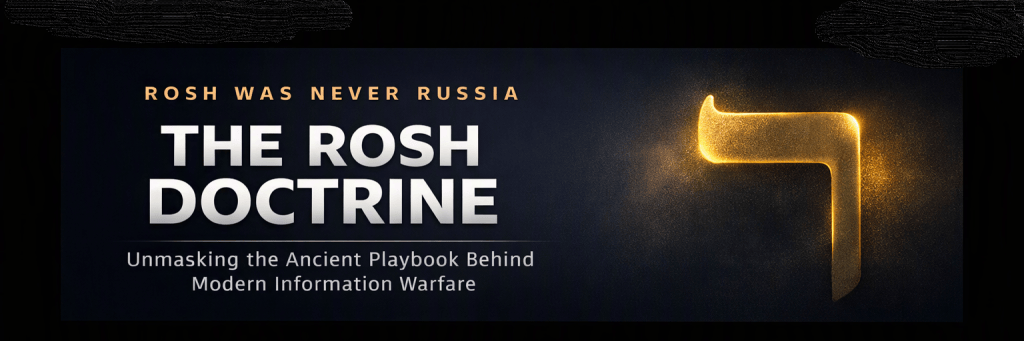
Every few years, a headline resurfaces: a Bible prophecy scholar on cable news, tracing the word “Rosh” in Ezekiel 38 to modern Russia, usually timed to whatever Moscow is doing that month. It’s a tidy reading. It’s also, on the Hebrew text’s own terms, almost certainly wrong — and chasing the right answer leads somewhere far more unsettling than a geography lesson.
Start with the word itself. Rosh (ראש) doesn’t mean a place. It means “head” — the same word used for the top of a mountain, the leader of a tribe, the beginning of a calendar year. Its first appearance in Genesis has nothing to do with armies at all; it’s simply the word for source. By the time Ezekiel uses it centuries later, naming it alongside Meshech and Tubal as part of a coalition gathering against Israel “in the latter years,” readers have a choice: treat it as a proper noun that happens to resemble a modern country, or ask what the word is actually doing everywhere else it appears in Scripture first.
Here’s what should give you pause. Trace rosh backward through the text, and a pattern emerges that has nothing to do with Slavic geography and everything to do with a method: deception that doesn’t attack the body, but the head — the source, the leadership, the thing that directs everything beneath it. Balaam never defeated Israel in battle; he corrupted its leadership from within. Delilah didn’t overpower Samson; she patiently dismantled what led him. The Gibeonites didn’t fight Israel’s army; they talked their way into controlling a decision at the top. Scripture keeps returning to the same doctrine: when direct confrontation means losing, the weaker side wins by controlling the head.
So what if Ezekiel wasn’t naming a country at all — what if he was naming a doctrine, one old enough to predate Russia by three thousand years and current enough to describe this week’s headlines about information warfare, coordinated disinformation, and the deliberate reshaping of what entire populations believe to be true?
That’s not a claim that any modern nation is secretly “Rosh.” It’s not a doomsday countdown, and it isn’t aimed at any people or government. It’s an invitation to test a pattern against the text itself, word by word, the way the Bible asks to be read — and to notice that the oldest weapon in recorded history was never the sword. Scripture seems to have known that long before anyone needed Ezekiel to predict a specific army at all.
If that question interests you, I trace the whole argument — from Genesis to Ezekiel’s Gog and Magog to the information wars of the present day — in The Rosh Doctrine: Unmasking the Ancient Playbook Behind Modern Information Warfare.
📖 Get your copy, and my other books: https://www.amazon.com/stores/Jim-Paige/author/B0HHYFGTB5

