
“Those that fail to learn from history are doomed to repeat it.” I wish those are my words. I found them in a 1948 publication, “The Gathering Storm” by Cassell & Co Ltd. The author, Sir Winston Churchill (1874-1965) shares this first volume in an epic series depicting his Second World War memoirs.

Churchill was British Prime Minister from 1940 to 1945 during most of the global conflict. He is largely remembered as a brilliant allied strategist and the hero of 1940. There is even a statue immortalizing him outside Parliament in Westminster, London. He is credited for inspiring the British people at their darkest hour from the brink of defeat, to the country’s finest hour of victory against Nazi German. Surprisingly Churchill was voted out of power soon in 1945 after World War Two ended. Out but not finished, this war hero became Prime Minister of the United Kingdom again between 1951 and 1955.
In 1953 Churchill earned the coveted Nobel Prize in Literature for his raft of fascinating political historical and biographical works. Nearly half a century before Winston Churchill described Uganda as the “Pearl of Africa” in; “My African Journey” published in 1908. Did Churchill have any idea his compliments would become such a catchphrase later in local politics, tourism, brand designers, educationists, music artists, etc? I guess not, otherwise his copyright revenue would keep flowing steadily into the family cash register long after he is gone.
Come Independence Day 60th anniversary on October 9, 2022 we ask; has the “Pearl of Africa” lived up to Winston Churchill’s fond assessment of then British Protectorate he just toured in the middle of continental Africa?
Pre-independence economic indices by the World Bank often lined up Uganda in the same paragraph with the likes of; Australia, Chile, India, Mauritius, Turkey and the United Arab Republic (UAE), Republic of Korea (KR) and South Africa.
Among the new post-independence nations, Uganda featured consistently as one of the best economic performers in Africa, with a very promising outlook on the world stage. Per capita Gross Domestic Product (GDP) in 1965 was $111. Equivalent value of 100 in 1965 is worth a staggering $3,570.01 today (0.93 percent average inflation rate per year). All this hinged on a predominantly agricultural economy, a tiny fraction of mineral and manufacturing export and, a scarcely educated human resource of about 7.6 million sharing 75,000 square miles of land.
Uganda GDP 1960-2022 – Data Source: World Bank
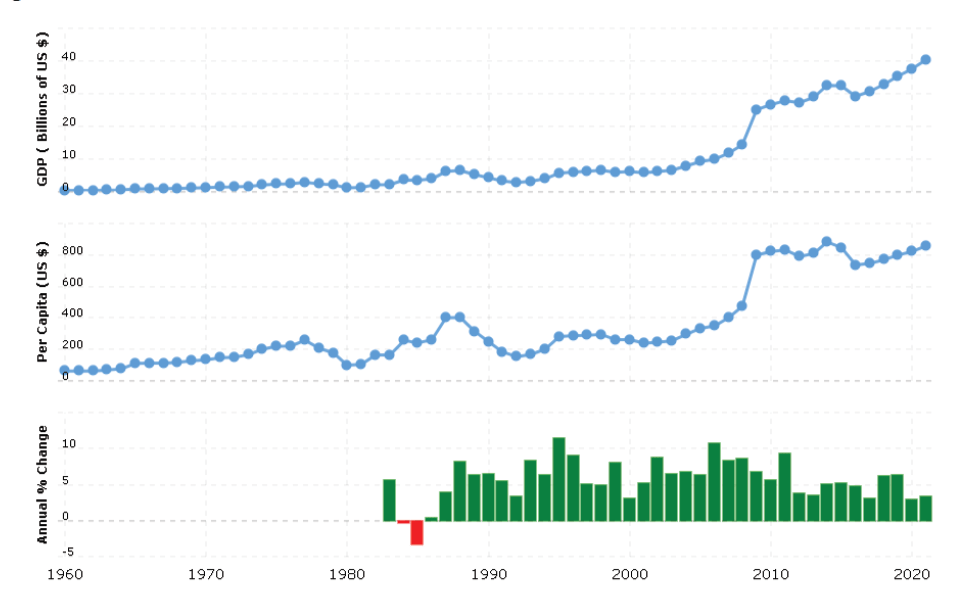
Fast forward 2022-23, one could only imagine what would have been if Uganda could hold it steady economically. With the right policies in place to keep hyperinflation in check that kind of performance would certainly make the seven of the world’s advanced economies (G7) club take notice.
Uganda’s population has grown almost seven times bigger compared to 1960 survey. According to Trading Economics econometric models, Uganda Population projected to trend around 48.96 Million by 2022. It is an impressive milestone indeed. But how does this new human resource capacity measure up against the country’s total income divided by its population?
According to the World Population Review 2021-2022 report, Uganda is placed number 19 on the list of the Poorest Countries in the World. Rwanda makes it slightly higher on number 7 with Burundi topping the chart on number 1. This ranking is based upon the 2020 GNI per capita, Atlas method (current US$) – World Bank.
Both metrics, GNI and GDP per capita measure economic conditions. However, experts consider GNI a slightly more accurate metric of a country’s all-round economic snapshot.
The FocusEconomics Magazine projection for 2025 Top 5 Poorest Countries in the World paints even a grimmer picture. Uganda takes third (3) spot with a projected USD 1,100 GDP per capita. Unless the economic slipstream changes dramatically, Rwanda is projected to slip up a place to fourth (4) with a projected: USD 1,122 GDP per capita. Mozambique could rank in above Uganda in second (2) place: USD 607 GDP per capita in 2025.
Compared to other Sub-Sahara Africans, Uganda embraced the dawn of digital age quite early. Almost every adult in the country currently own more than one cellphone, enabled for the indispensable ‘mobile money’ local financial transaction cauldron. According to GSMA 2021 survey – The state of mobile internet connectivity in Sub-Saharan AfricaCellphone – coverage in rural Uganda has reportedly archived an astonishing 85 percent. Social media craze such as; YouTube, twitter, Facebook, TikTok, etc not the preserve of Western teenagers. Literacy among the population is on all-time high. Industry, manufacturing and tourism outstrip the 1960s levels by far. But why has the economic growth rate charted a different, often uneven trajectory to the population growth and massive benefits of the digital age?
“The five poorest countries are all from Sub-Saharan Africa, a region which continues to be held back by problems such as institutional weakness, corruption, poor infrastructure and a lack of human capital.” – The FocusEconomics Magazine.
Trying to contrast Uganda’s swelling 48.96 Million with the last part, “. . . a lack of human capital” would probably not hold up. Unfortunately the many thousands of graduates pumped out of Uganda’s abundant colleges and universities cannot find a job for their skills locally. Job creation mechanisms to match the population growth have remained stagnated for years. Consequently, that void has been claimed by a host of opportunistic operators. Every year, tens of thousands of brilliant Uganda graduates are flown out mainly to the Middle East, Gulf States, Turkey, Malaysia, and China. Most get coerced into accepting low pay domestic contracts against of their hard-won skillset. It is a practice that many international human rights activists and labor unions around the world now widely dismiss as modern-day slavery on an “airbus scale”.
Kampala hypes fostering a vibrant labor market export as one of the government’s many success stories. But most economic experts argue that the brain drain that deprives local markets and services capacity to innovate and create jobs is simply not worth it. Revenue indicators on the annual foreign currency repatriations by migrant workers are just but mirage refraction to the enormous social-economic burden their families back home endure. The depressed economy is largely precipitated by insatiable corruption, massive cost of government, colossal debt servicing, greater inflation and a bigger import bill mainly from China. Consumer prices constantly pushed up by elevated commodity prices severely hindering private consumption.
From every angle proponents try to sell it, any unbalanced labor export model would simply benefit rivals while keeping the supplier nations professionally subjugated with negligible economic benefits.
At the end of their contracts, majority of those migrant workers would return home to the same depressed economy they left behind, in some cases even worse. Most would face an uphill task trying to fit back in the same communities they left. Some would be aged, injured and unemployable. Currently, there is no known social facility in Uganda to cover former migrant nationals of pensionable age when they need state support. Neither is there any legislative proposal to adopt something close any time soon.
Churchill spruced up his “Pearl of Africa” phrase with adjectives like; “For magnificence, for variety of form and color, for profusion of brilliant life — bird, insect, reptile, beast . . .”
Apparently, he was looking through a vacation (Safari) lens back then. But what would the next vision look like if he’d switched to a social-political lens? A, Gathering Storm?
Sir Edward Mutesa II, the Kabaka (King) of Buganda, became the President at Uganda’s Independence on October 9, 1962. Some sections of the infant republic’s local politicians labelled the political monarchy as arrogant and myopic. Executive Prime Minister Apollo Milton Obote angling to take advantage ousted his President in 1966. The monarch was exiled to London where he died in 1969.
Milton Obote was overthrown by his own Army Chief, General Idi Amin in 1971. He returned to power in 1980 a year after a brutal war launched from Uganda’s southern neighbor Tanzania ousted Amin in 1979. There was a brief electioneering moment. Milton Obote lived up to Churchill’s prediction, “those that fail to learn from history are doomed to repeat it.” He was forced out, again this time by the guerilla war that brought Yoweri Kaguta Museveni to power in 1986.
The following year (1987) the Lord’s Resistance Army (LRA), a quasi-Christian rebel group brought terror back to the north. LRA leader Joseph Kony (a former Catholic) stated their objectives. First, to overthrow the Museveni government and install an alternative that would run the country according to the Biblical Ten Commandments. Then, he’d take his turn on the national cake based in Kampala since Independence Day from Britain. The violence executed by Kony’s Lord’s Resistance Army (LRA) was maniacal in its brutality. The group targeted innocents, abducting children and forcing them to commit inhumane acts of brutality—often against their own families—before using them as child soldiers in its military campaign.
While human toll is hard to calculate, during the early 2000s, local and international media sources estimate 120 to 150 people reportedly died daily as a direct result of the LRA conflict. Harsh conditions in the squalid displacement camps where many fled to avoid LRA attack also attracted a wide range of killer disease that claimed many more lives.
The LRA left Uganda in 2006, and the millions affected by the war have since been trying to rebuild their lives after yet another generation of war. Meanwhile, poverty-related diseases, malaria, diarrhea and malnutrition continued to kill hundreds of Ugandan children every day.
World Vision estimated some 4 percent of infants in Uganda die in their first year of life; 9 percent die before the age of 5.
On April 2012 World Vision released a viral video phenomenon Kony 2012 that spurred millions of people around the world in the “Cover the Night” charity fundraising for the child victims of the LRA.
In the video, World Vision issued a warning that, while now-infamous warlord Joseph Kony no longer threatens Ugandan communities, invisible killers continue to stalk the nation’s children—killers with far more reach than Kony’s army, even at its worst.
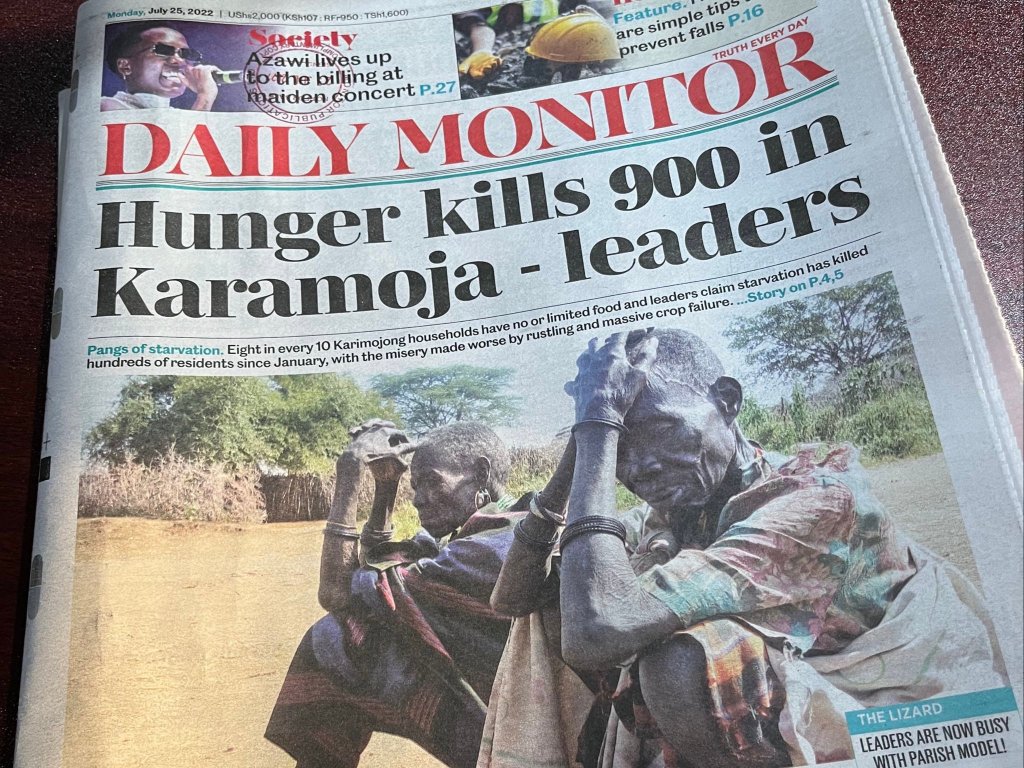
As the champagne bottles get dusted off for the next October 9, 2022 Independence Day national event, media reports describe apocalyptic conditions in the mineral rich Karamoja region of North-Eastern Uganda. Heart wrenching images display clusters of livestock carcasses strewn across parched savannah wasteland. Everywhere severely malnourished children clutch at their skeletal adults folks with hapless eyes sank deep in. More than half a million of the 1.2 million people are reportedly threatened by acute food and water shortages in Karamoja. Local and regional Non-Governmental Organizations (NGOs) have been trying to help with limited resources and stifling bureaucratic interference. Stinging criticism from different corners has finally spurred on the central government and some illustrious political opposition figures to provide much needed relief. Critics argue the government has deliberately kept the region backward while busy exploiting its variety of precious minerals including limestone, marble, gold and uranium. Kampala conveniently blames insecurity from “criminal and outdated” cultural practices of cattle rustling (raiding) in the Karamoja region for hampering development efforts.
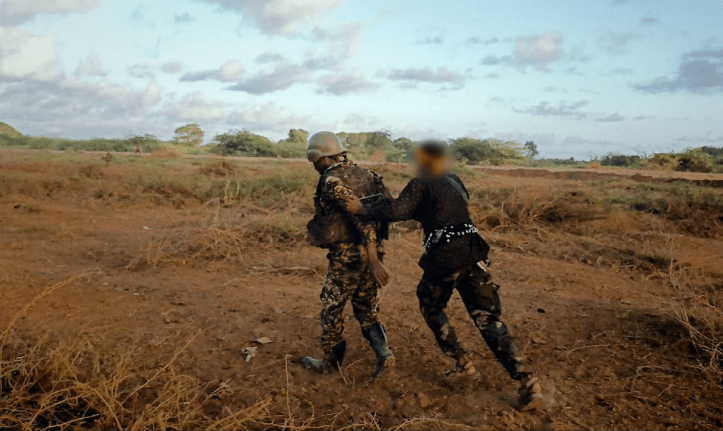
Under President Museveni, Uganda has somehow managed to freeze devastating internal conflicts and military intervention. However, systematic militarization of Police, the frequency of armed troops on streets and heavy menacing machine gun mounted armored trucks in strategic intersections is a constant reminder that perhaps trouble is not too far off. Young Uganda soldiers have been involved in other regional armed hotspots such as Southern Sudan. Since March 2007, Uganda has deployed and maintains over 5000 combat troops to war ravaged Somalia. Their deployment began as part of the African Union Mission in Somalia (AMISOM) contingent against jihadist Al-Shabaab militants. Fifteen years later the operations crept into what became The African Union Transition Mission in Somalia (ATMIS)
On December 1, 2021 Uganda troops launched an open-ended operation in eastern Democratic Republic of Congo (DRC). Kampala claims their troops were invited across the frontier to help their DRC allies defeat the Allied Democratic Forces (ADF) armed group.
Somehow, scenes of cargo planes offloading Uganda’s casualties from regional conflict zones at Entebbe International Airport no longer make headline news.
Accordingly, it is inconceivable that ordinary Ugandans grappling with a number of domestic issues including; economic anxiety, political decadence and social depravity can rationalize celebrating Independence Day. Meanwhile, crews of preselected contractors are moving full steam ahead, effecting lucrative government hospitality deals for the event. In a normal democracy that level of indifference could help attract nothing less than political suicide. But in this part of the world, it doesn’t really matter who cast the ballot as much as who get to count the votes. Some version of a quip commonly attributed to former Soviet Union Communist tyrant Josef Stalin extolling the “power of vote counters” on state payroll.
The existing political opposition breed has not been able to raise above populist rhetoric either. Local “beer table prattle”, ironically dismiss anything in opposition colors as nothing more than slimy operators, busy ingratiating themselves into the doldrums of compromise and selfishness. Some analysts credit the opposition dysfunction to the ominous phrase by President Museveni during the violent 2021 electioneering period, “we shall crush . . .”
Here comes the next question. When is 60 years of Uganda’s independence not just a number? On July 9th, 2022 northern neighbor, The Republic of South Sudan celebrated its 11th birthday since that bloody separation with the Sudan. Regrettably, bouts of violence have continued to blight their journey too. It has been just over 60 years since The DRC; Uganda’s larger neighbor west gained Independence from Belgium on June 30, 1960. Rwanda, which shares borders with both Uganda and the DRC, has also controversially been linked to the protracted instability. This shaky axis and its people are living in perilous times indeed.
With the Soviet Union relegated to the history pages and the Cold War gone, it looks like geopolitics has simply been somewhat redefining spheres of conflict. It all began with the West and former colonial masters redefining their priorities. Just like telling former allies that when you create problems in your own house go ahead and solve your problems in your own house.
At that brief moment when the West and former colonial powers had their heads in the sand they didn’t realize that sadly there is a new kind of storm gathering on the horizon. The West’s retraction meant undermining themselves to their detriment, and of traditional allies, that would rally around then for the cause instead of getting into compromise with the rival. It is a basic law of physics that when you create a void someone or, something somewhere is going to fill that void. The advisory saw a window of opportunity to be able to entrap the prey in an untenable position of weakness.
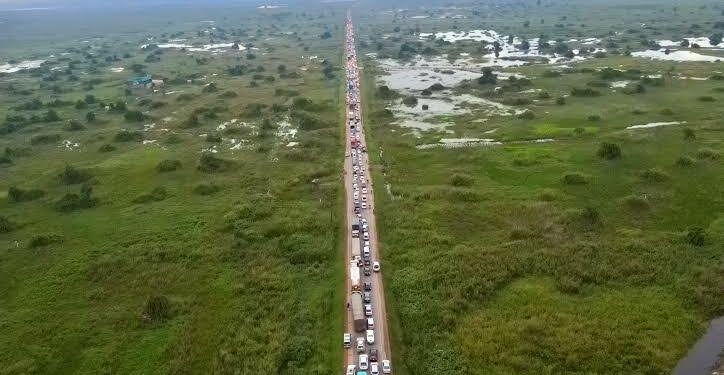
Environmental devastation of Lwera swamp from Chinese rice growing, sand mining and aggressive reclamation for factories
Soon, the Chines came looking for anyone who is willing to aide and abate their desire of conquest and dominance on the global scale. They advertised no-frills aid in megaprojects coupled on a relationship of necessity. Opportunist regimes around the world that have always loathed the idea of democracy demands being bolted on to international aid felt there has never been such a great time to cash in. They jumped on the wagon and become the tic that latched on to the victim and began pulling in many different directions.
Twenty years don’t feel like such a long time ago. But that is what it has taken (in some cases even less) for rampaging Chines corporations and their host affiliates to perpetuate irreversible environmental ruin. From South America acres of receding jungles and heavily polluted water resource; to Central-East Africa shrinking marshland, excessive quarrying & mining, depleted fresh water fisheries, waste dumping, plastics proliferation, degraded air quality, etc.
Defenders of the Chines CCP policy point to the glittering steel and concrete structures mushrooming in many urban centers. The pet projects are often peddled as gifts from the bottomless pot of Beijing generosity. But behind the scenes, the noose of crippling debt keeps tightening to afflict the host populations for generations to come. While majority of those populations have always relied heavily on agriculture to manage their economic fortunes, the rapidly changing eco-system means that is now out of the equation. Soon, many will wake up to the realization that their greatest assets the colonialist left behind for the locals to run have now been mortgaged for something not worth celebrating about.
In Uganda, it is a very sensitive subject attempting to explain publicly any positives that the colonials left behind. Local politicians excel in resurrecting colonial sins wherever they can find a podium and a microphone. You can almost guess what the central theme of the President’s next Independence Day speech is going to sound like by simply looking at the last one.
Uganda has a majority young population and millions of immigrants most who were not even born in 1986 when the current regime came with guns blazing. But they are being told the same story over again that it was the pivotal point of liberation for the nation.
So how else does anyone get such a young and diverse people to believe in the idea that their nation could do much better for their children’s future and beyond?
Regime snoops have picked up the local “beer table” psychobabble too. They have learned that the “sale-by” date of the “liberation” narrative has passed. They also know that one of these days someone out there will come knocking, armed with those infamous buzz lines of Churchill’s prophetic story, “The Gathering Storm”. They can tell their method is wilting away so they are setting themselves up for a grand finale. All the good students of history have to do now is to read into the regime’s grand strategic plan which is more violence.
The best student of history from the last 60 years also knows that they cannot be baited to the same methods employed by those that have gone before them. The colonialists did not come in firing. They did not exit firing either. It all comes down to service and sacrifice hinged upon faith in the God.
During his last visit to Uganda on February 4, 2020 as Israeli Prime Minister, Benjamin Netanyahu was heard by the press saying some nice words to his host. “I have a simple suggestion; you would want to consider Mr. President, my friend. You open an embassy in Jerusalem; I will open an embassy in Kampala. We hope to do this in the near future. In all other ways, there is a stack bond between us; you’re a man of the Bible”. President Museveni declined and hung his reasons to the unsettled Israeli territorial issues with the Palestinians.
Just like many of his most decorated cadres, President Museveni has always quoted the Bible especially ahead of a public announcement that could spark public disquiet. When COVID-19 arrived, the President quoted Isaiah 26:20 and began a series of severe public restrictions that lasted for a larger part of two years. His time and performance at the helm in the echelons of power suggest how convenient it can be to not believe in what the Bible has to say and still have your way when quoting from it.
For the believer looking at things from a Biblical lens, Uganda could be at the doorsteps of their Romans 5:3 moment.
“And not only that, but we also glory in tribulations, knowing that tribulation produces perseverance; and perseverance, character; and character, hope.”
That is where Faith Triumphs in Trouble. It means the next mega change is going to be bloody in the cosmos so it doesn’t have to be in the physical. The terms of the conflict have already been settled in the courtroom of history, judgement and mercy – (Revelation 19:11 Isaiah 33:22).
Where does this leave the unbelievers who love their country and hope for better days ahead as we all try to face down the same storm gathering on us?
They are in the right place. Some people are looking at some sort of a national unity platform. That is their right too. Others are busy calling upon the ancient astral deities their forefathers followed. But is there something of a triumphant entry there we can glean from the churchillian quotes?
In the next post, we are going to dive deep into some interesting Biblical technical details to help us drive home some key elements of this subject.
Please track with us, there is so much more to come in part two (2) when you follow thisa link . . . Bless.


One response to “60 – A PIVOTAL MOMENT FOR UGANDA”
[…] is a continuation of where we left off when we introduced this topic evaluating Uganda’s sixty (60) years of Independence from Britain. At this stage we are taking a detour from the social-political overview and wrapping things up on […]
LikeLike